Identity Theft After Motherhood: Finding Yourself as Your Child Grows Up
Aug 07, 2026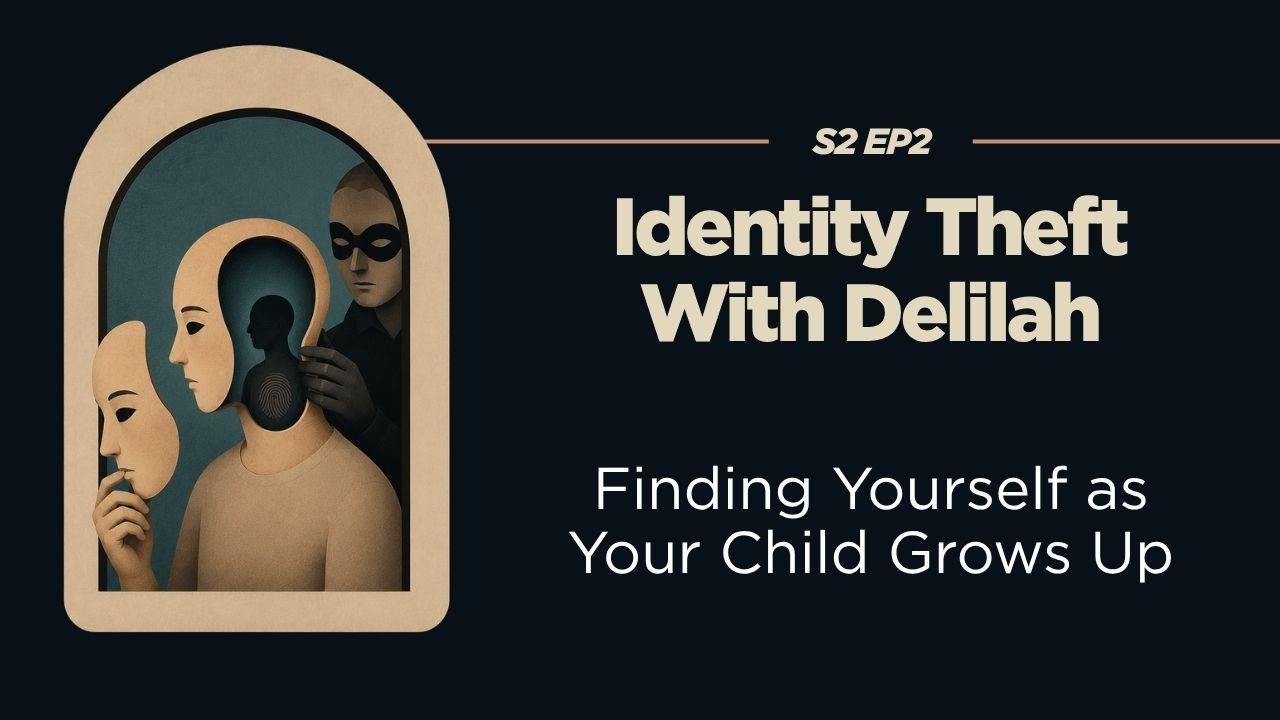
Podcast Companion Article for Love Your Villain – Season 2, Episode 2
When Motherhood Has Been Your Name for Years
For years, Delilah Patton has been known through the roles she performs beautifully: mother, school volunteer, caregiver, partner, aesthetician, artist, and the person who keeps the emotional threads of family life connected. Now her teenage son needs her differently—and that shift has created a question many parents quietly carry: Who am I when I am no longer needed in the same way?
In this episode of Love Your Villain, Ila and Delilah call the experience “identity theft”: the gradual loss of a self that can happen when caregiving becomes the centre of life, followed by the disorientation of watching a child become independent.
This is not a story about loving a child less. It is about making room to love the person who raised that child, too.
Meet Kyle: The Villain Who Refuses to Be Controlled
Delilah calls her villain Kyle: stubborn, rowdy, rebellious, and fiercely resistant when other people make decisions for her. Kyle formed around a familiar wound. As a child, Delilah often had to fend for herself; when rules suddenly appeared, a protective voice asked, “Where were you before—and why should you decide for me now?”
For a long time, Delilah defaulted to keeping the peace. Therapy, communication coaching, and honest conversations with her husband helped her see that the answer was not to banish Kyle. It was to integrate the useful part of him: the part that asks for space, names a need, changes the channel, and says yes to Delilah.
A villain is not always evidence that something is wrong with us. Sometimes it is an awkward, overprotective messenger carrying a need we once learned was unsafe to express.
The Identity That Can Swallow Every Other Identity
Being recognized as her son’s mother brings Delilah genuine pride. People tell her he is charismatic, thoughtful, and principled. She can see the values, conversations, and care that helped him become that person. Parenting has been meaningful work—even when the culture does not treat it as work.
But pride and disappearance can coexist. Delilah also lights up when someone recognizes her for something that belongs to her alone: a memorable facial she gave years ago, her art, her dancing, or her burlesque performances. Those moments return a name that can get buried beneath “someone’s mom.”
The challenge is not to reject motherhood. It is to let motherhood become one part of a larger identity again.
When Being Needed Begins to Change
The shift arrived gradually. Her son started staying out after school, navigating transit, cooking for himself, and house-sitting while his parents travelled. He still needed guidance, but he could increasingly function without it.
That independence is the outcome parents work toward—and it can still feel like grief. When self-worth has grown around being necessary, a child’s competence can register as both success and loss.
Delilah and Ila offer a more generous frame: parenting does not end when dependence decreases. It evolves from doing everything for a child to becoming a safe adult they can return to, talk with, and choose.
From Being Needed to Being Chosen
Delilah already sees glimpses of that future. Her son learns drum riffs from music she loves. He brings her ideas about politics and social justice. He imagines going dancing with her when he is old enough. These are not acts of dependence. They are acts of relationship.
Being chosen can be quieter than being needed, but it may be the clearest evidence that connection has survived adolescence. A teenager who still wants to share a song, a meal, an idea, or a joke is not pulling the family apart. They are building a more adult version of belonging.
Reclaiming the Parts That Went Quiet
Motherhood asked Delilah to tuck away parts of herself: the woman who went to wild dance parties, made art, dressed boldly, and performed. As her son grows, those parts are returning—not as a rejection of family, but as an expansion of what a parent is allowed to be.
Letting children see that their parents are full human beings matters. It normalizes creativity, sensuality, imperfection, friendship, ambition, and change. It also gives children permission to become complex adults themselves.
Reclaiming identity can begin small:
- Protect time that belongs only to you.
- Return to an art form, community, movement practice, or interest that once made you feel alive.
- Ask for a need directly instead of waiting to be noticed.
- Reconnect with people who know you beyond your caregiving role.
- Notice where your child is choosing you, not simply needing you.
- Treat uncertainty as an opening for experimentation, not proof that you have failed.
Returning to Work After Years of Caregiving
For Delilah, rediscovering identity is also practical. Physical limitations mean she cannot simply return to medical aesthetics, while years of child-rearing make resumes, retraining, and job searches feel daunting. The problem is not a lack of ability. It is translating years of invisible labour into language the workplace recognizes.
Caregiving develops real skills: conflict navigation, scheduling, advocacy, emotional regulation, budgeting, adaptability, teaching, project coordination, and crisis management. A career transition may require retraining, but it should not require pretending those years were empty.
Delilah is starting where energy and community already exist—volunteering in arts and culture, making connections, and exploring ways her creative work might become paid work. She does not yet have a tidy answer. That honesty is part of the episode’s power: reinvention is often visible only in hindsight.
Community Is Part of Identity
Delilah and her husband have built a network of chosen aunts, uncles, friends, artists, and safe adults around their son. That community supports him, but it also reminds Delilah that her value does not begin and end with a single role.
Identity is relational. We remember ourselves through the people, places, and practices that reflect more than one version of us. Volunteering, creating, learning, working, dancing, and asking for support are not distractions from motherhood. They are ways of building the next chapter of it.
Reflection Questions
As you reflect on this episode, consider:
- Which parts of you became quieter while you were raising children or caring for others?
- Where has being needed become connected to your sense of worth?
- What does your inner villain protect when you ask for space, autonomy, or recognition?
- How is your relationship with your child changing from dependence to choice?
- What skills did caregiving teach you that deserve a place on your resume—or in your next chapter?
- Which community could help you feel visible as yourself again?
You are not disappearing because a role is changing. You are meeting the person who has been there underneath it.
Listen to the Full Episode
In Season 2, Episode 2 of Love Your Villain, Ila talks with Delilah Patton about identity after motherhood, integrating the rebellious villain named Kyle, raising an emotionally aware teenager, returning to work, disability, creativity, chosen family, and the tender shift from being needed to being chosen.
In this episode, we explore:
- Why a child’s independence can feel like both victory and grief
- How caregiving can become a parent’s dominant identity
- What villain integration looks like in everyday relationships
- Why parents deserve identities beyond service and sacrifice
- How volunteering, creativity, retraining, and community can open new paths
Listen to Love Your Villain on Apple Podcasts or Spotify.
Further Exploration
If this conversation resonated with you, these resources offer practical next steps and deeper context.
Books
- Life Reimagined: The Science, Art, and Opportunity of Midlife — Barbara Bradley Hagerty
- Mothershift: Reclaiming Your Life After Motherhood — Jessie Harrold
- Unraveling Motherhood — Geraldine Walsh
- Hold On to Your Kids — Gordon Neufeld and Gabor Maté
Articles and Career Tools
- An Empty Nest Can Promote Freedom and Improved Relationships — American Psychological Association
- Career Exploration Hub — WorkBC
- WorkBC Centre Services — resume support, training, career planning, and self-employment services
- StrongerBC Future Skills Grant — funding for eligible short-term training
Local Vancouver Resources Mentioned in the Episode
- Enterprising Women Making Art (EWMA) — creative development and self-employment support
- Vancouver Cherry Blossom Festival — volunteer opportunities in arts, culture, and community
Topics
- Identity after motherhood and the empty-nest transition
- Villain integration and emotional literacy
- Caregiving skills and career re-entry
- Chosen family and intergenerational community
- Parent–teen connection, autonomy, and healthy boundaries
Related Love Your Villain Content
ILA’S STORY